Writing / Artificial Intelligence
What Does Head Mixing in Coeff-Tuning Actually Solve?
A closer look at Coeff-Tuning's attention-head mixing, its toy example, and the boundary between what that experiment shows and what it does not.
Parameter-efficient fine-tuning usually acts on linear layers. LoRA and DoRA change how weight updates are parameterized, while Adapter and SSF insert a small number of trainable parameters into the feature path. Coeff-Tuning chooses another location: it learns how attention heads should be combined instead of directly rewriting the feature projections.
The interesting question is not whether it wins another benchmark table. It is narrower: what does the toy example used to motivate the method actually establish?
The method: a learned mixing matrix between heads
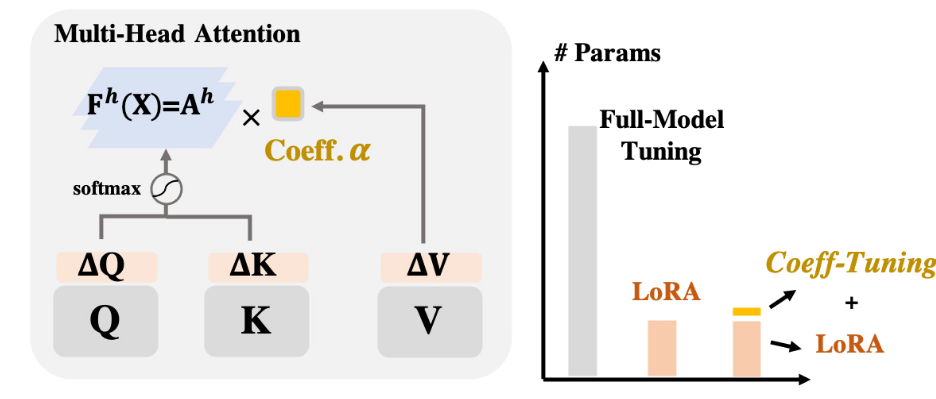
An attention layer with H heads produces H attention matrices. Coeff-Tuning introduces a trainable matrix alpha, initialized as the identity, and uses it to mix those matrices:
F_hat[h] = sum_i alpha[h, i] * F[i]
With an identity alpha, the layer reduces to ordinary multi-head attention. After training, one head can incorporate the relation structure learned by other heads. The method adds only H x H parameters and can be combined with methods such as LoRA that operate on the linear projections.
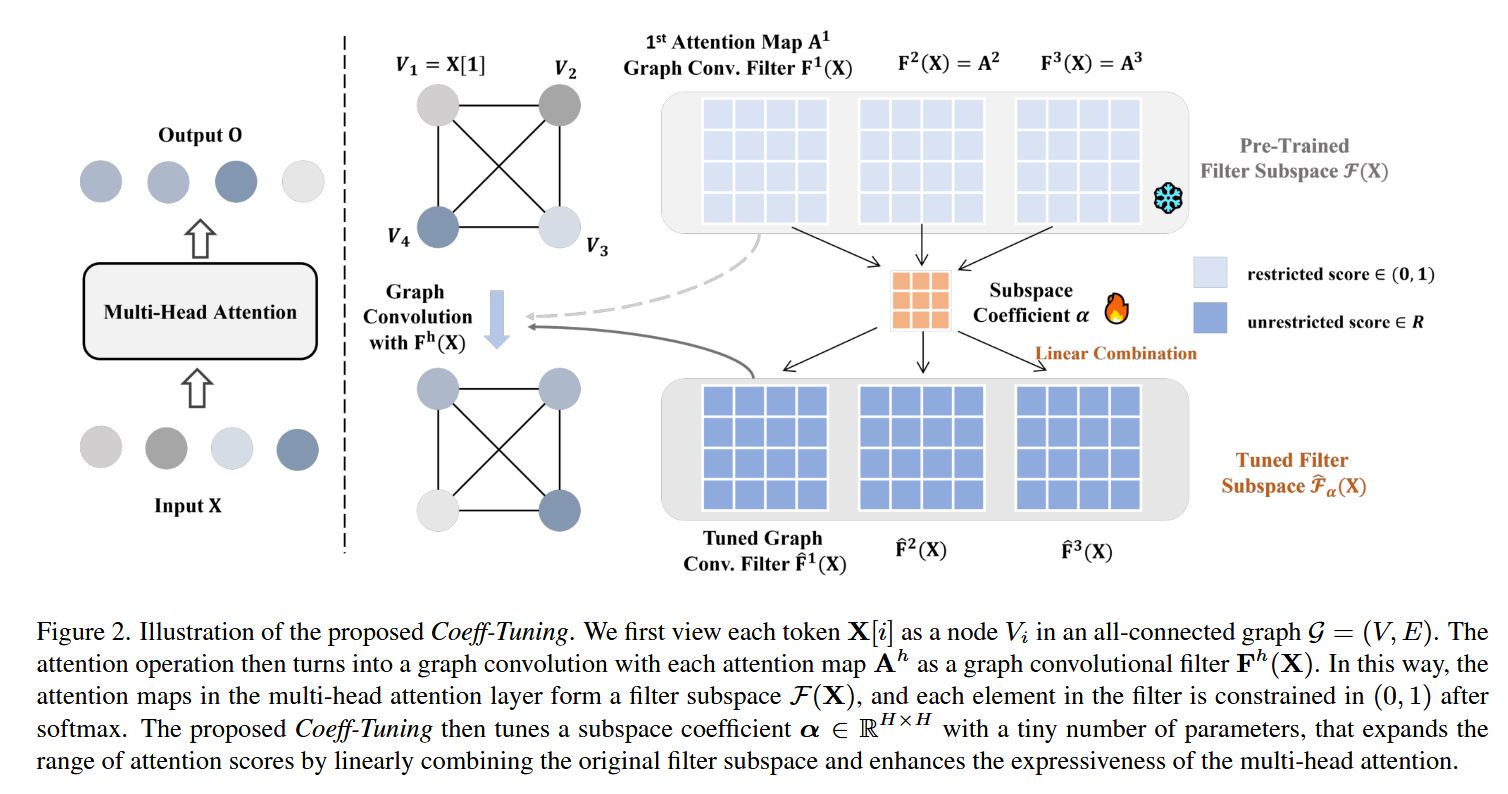
The intuition is clean. Standard multi-head attention partitions features into subspaces and computes attention independently in each one. alpha restores a communication path after those attention matrices have been formed.
Why the toy example looks persuasive
The paper constructs a sequence of eight two-dimensional tokens and asks one attention layer to map the input points to a target output. Its original configuration uses two heads with a head dimension of one.
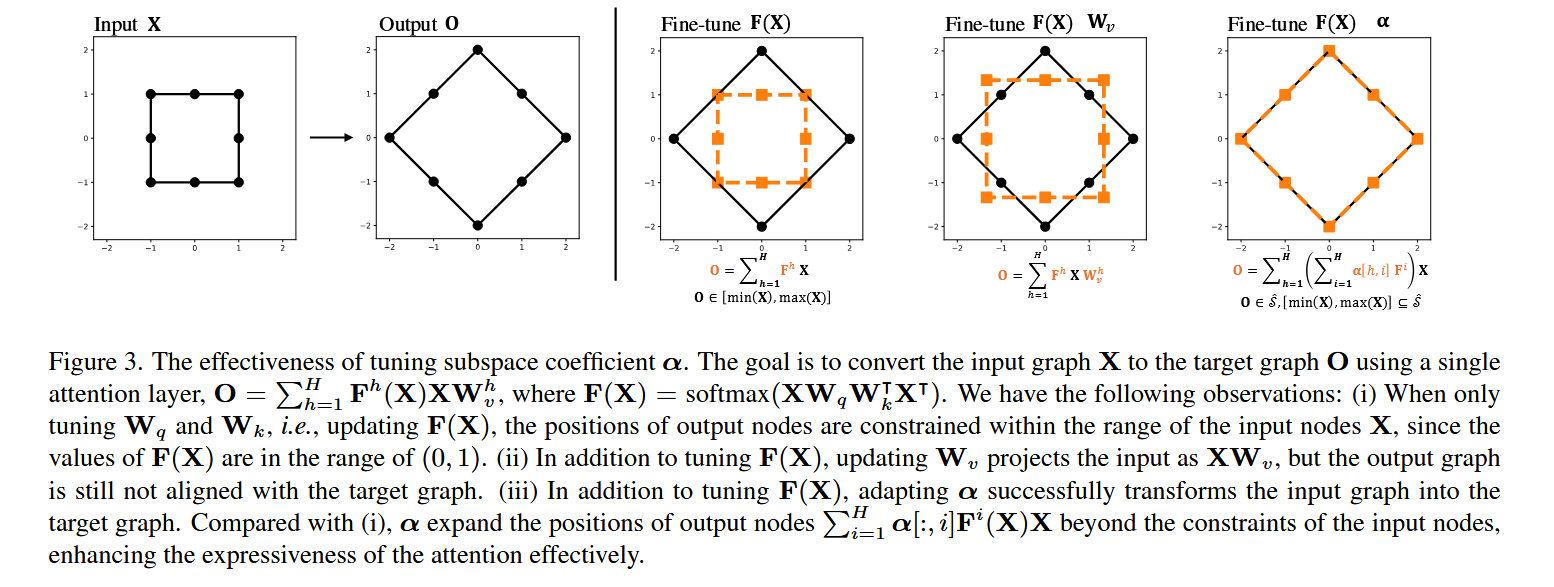
The reported progression is straightforward: attention without a value projection cannot perform the mapping; adding the value projection remains insufficient; adding alpha fits the target. The improvement is presented as evidence that head mixing expands the useful function space.
There is, however, a confound that is easy to miss. The two-dimensional features have been split into two one-dimensional heads. Each head must form its queries, keys, and values inside a one-dimensional subspace. That is already a severe representational bottleneck.
A different control: keep the two dimensions together
I changed the same toy task to one head with dim_head=2, allowing attention to operate in the full two-dimensional space without alpha. Under that configuration, the model can also fit the target output.
This does not invalidate Coeff-Tuning. A two-dimensional single head and two one-dimensional heads are not identical parameterizations; the comparison changes both the number of heads and their dimensions. It does show that failure in the original toy example cannot be attributed only to the absence of alpha. It may also result from the representational bottleneck created by the low-dimensional head split. In this setting, alpha repairs a lack of communication between heads, but that is not the same as proving that it is theoretically necessary for attention in general.
A more precise claim would be:
When individual attention-head subspaces are extremely narrow, head mixing can recover some of the expressive capacity lost by splitting the features.
What a stronger validation would require
Four controls would make the explanation substantially stronger:
- Hold the total inner dimension and parameter budget fixed while varying head count and
dim_head. - Repeat the experiment across random targets, seeds, and sequence lengths.
- Compare identity, dense learnable, constrained, and absent head-mixing matrices.
- Report attention rank, inter-head similarity, and output-subspace changes in addition to final fitting error.
Those controls would separate two hypotheses: whether Coeff-Tuning generally adds a useful function class to standard multi-head attention, or whether it primarily repairs expressivity lost under particular head configurations.
Head mixing is still a useful place to tune
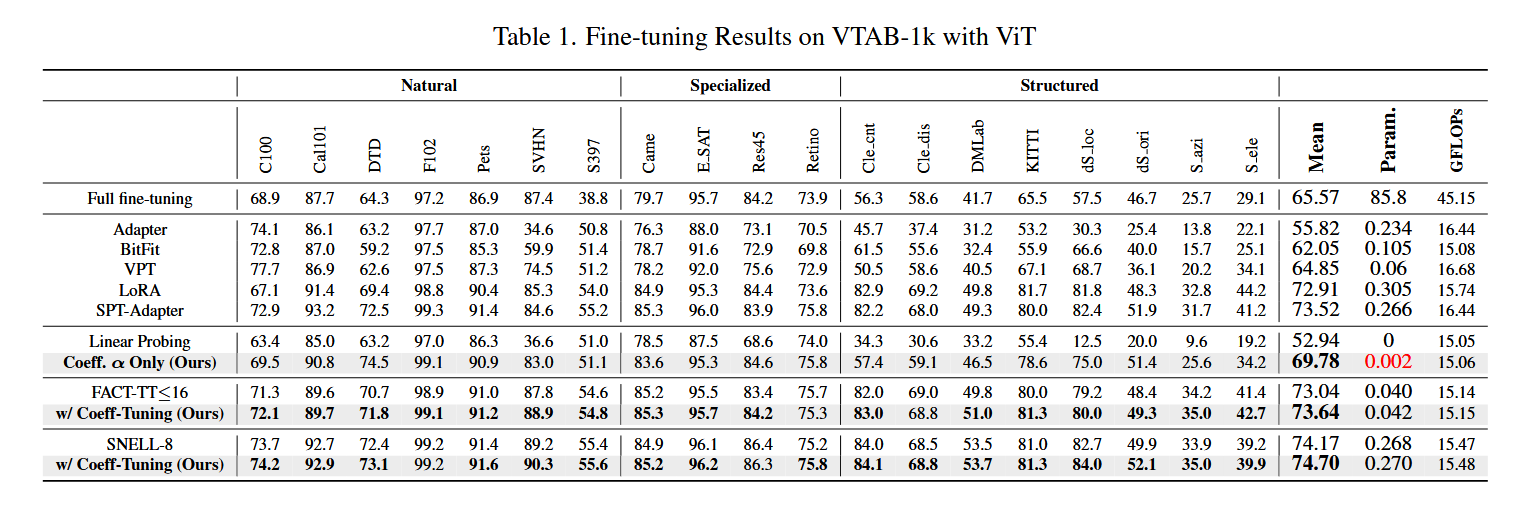
Even with a narrower interpretation of the toy example, the method remains practically interesting. It adds very few parameters, is orthogonal to low-rank weight updates, and turns the question of which heads should share relational structure into something that downstream data can learn.
The lasting lesson for me is methodological rather than another PEFT ranking. When a tiny parameterization produces a large gain, it is worth asking whether it creates a genuinely new capability or compensates for a restriction that the original parameterization introduced.